|
|
Rail 101Building for the future requires that we understand what exists today. Here you'll find an introduction to basic rail concepts, as well as a map of rail lines and services that currently exist in the San Francisco Bay Area.
Why trains? Types of trains Trains and grade separations Trains and noise Click in square in map below for south bay detail
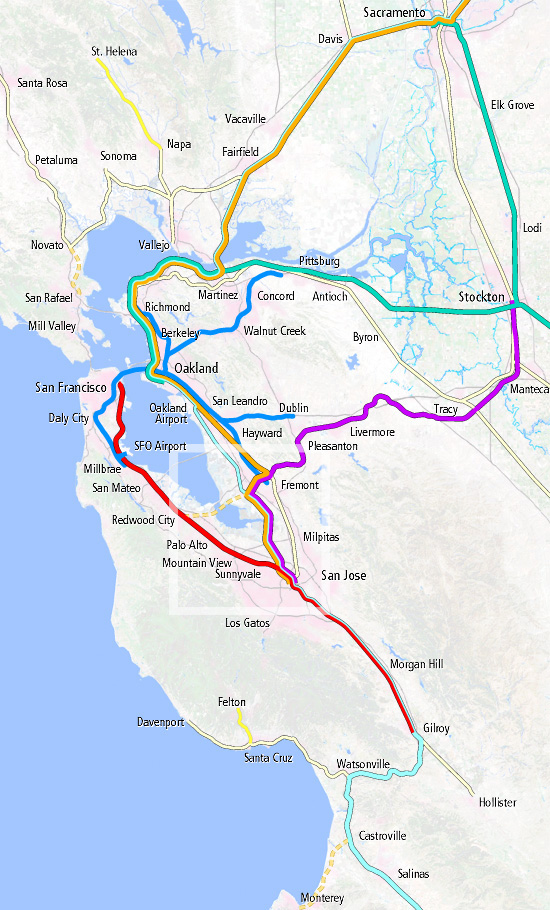
Passenger ServicesPassenger rail service is provided by Altamont Commuter Express (ACE), Amtrak (Capitol Corridor, Coast Starlight, California Zephyr, San Joaquins), BART, and Caltrain. Tourist excursion trainsDesigned to provide a historical, entertaining experience rather than transportation per se.
FAQ What is the difference between Caltrain, Light Rail, and BART? How does a train line compare to a highway lane in capacity? Don't trains actually create congestion at intersections? History FAQ Why doesn't BART go around the Bay? Why did the BART-Millbrae-SFO extension perform below expectations? Why are there only a few round-trip trains going to Gilroy? Why isn't there rail on the Bay Bridge? FAQ About Rail 101Rail 101 Milestones1964: Branch line from California Avenue in Palo Alto to Los Gatos is discontinued and some of the track torn up to make way for the Foothill Expressway. May 1, 1971: Amtrak takes over operation of the nation's intercity passenger trains. The northern terminal of the Coast Daylight to Los Angeles is changed to Oakland from San Francisco so as to go through to Seattle. Southern Pacific's Del Monte, which ran from San Francisco to Monterey, is discontinued altogether. As a result, commuter trains become the only rail passenger service between San Francisco and San Jose. 1977: SP Petitions the state Public Utilities Commission (which says "no,") and then the Interstate Commerce Commission to discontinue its Peninsula commuter rail service. A bitter fight follows. After long months of negotiation, the three counties through which the train runs and the California Department of Transportation (Caltrans) reach an agreement with Southern Pacific. SP would become a contractor and the public agencies would cover most of the operating costs. December 27, 1991: The PCJPB purchased the 51.4-mile railroad right-of-way from Southern Pacific. The right-of-way, which runs from San Francisco to San Jose, cost $219 million. San Mateo County provides the funding with the understanding that San Francisco and Santa Clara County would pay San Mateo County back, promises that are later broken and which create a sore point between the counties. Included with the purchase were trackage rights for the rails between San Jose and Gilroy, with an option to acquire half the right of way at a cost of $30 million (check this number). Santa Clara County fails to pursue this option to buy the right of way, and it expires in 1996. July 1, 1992: The PCSJPB becomes the Peninsula Corridor Joint Powers Board and assumes operation of Caltrain, taking over from Caltrans. The JPB contracts with Amtrak to operate the service. Six off-peak trains are added to increase weekday service from 54 to 60 trains. Tamien station opens in San Jose and service is extended to Gilroy. New stations subsequently open at Capitol Expressway, Blossom Hill Road, Morgan Hill and San Martin. |