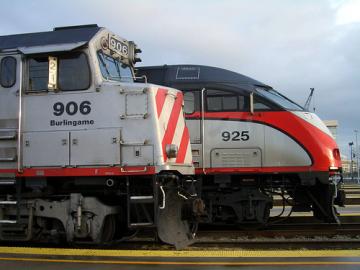
Caltrain bike tags

Make your own Caltrain bike destination tags using our template and a name badge holder.
picture of bike tag holder

Other tips to make taking your bicycle onto Caltrain a more pleasant experience for you and others.

Did You Know?

You may drink alcoholic beverages on Caltrain, on ACE (in lidded containers) and on the Capitols -- except not after 9 PM on Caltrain following a special event (like a Giants' game). Caltrain  tightened its alcohol policy after drunk and rowdy ballgame fans got into a fight on the train. Don't drink anything (alcoholic or not) on BART -- you could get arrested, as some people have, because no eating or drinking is allowed on BART.

Save Time and Money

Learn how you can save money and time on your transit trip -- see the left- and right-hand columns of our Plan Your Transit Trip page

Line 55 Monterey - San Jose Express

An express bus service makes 3 round trips daily from Monterey and Salinas to San Jose, with stops at the Gilroy and Morgan Hill Caltrain stations. Caltrain passengers with a three-zone or greater monthly pass ride free. MST customers with day passes or monthly all-zone passes are allowed free transfers to VTA local buses and light rail lines. For more information on Line 55, see the Monterey-Salinas Transit website or call toll free 1-888-MST-BUS1

Caltrain

Caltrain is a descendant of the San Francisco Peninsula's oldest intercity passenger rail system, which began in 1863 as the San Francisco and San Jose Railroad Co.  The service provides a fast, convenient alternative to driving the heavily congested Bayshore Freeway, (Highway 101) between San Francisco, San Jose and south to Gilroy. This popular commuter rail service continues to attract new commuters and travelers with major upgrades completed between 1995 and 2004.  Up to twenty 80-mph limited stop “Baby Bullet” express trains run weekdays between major stations taking just 57 minutes to complete their runs between San Jose and San Francisco.
   
 
courtesy Associated Students, SJSU
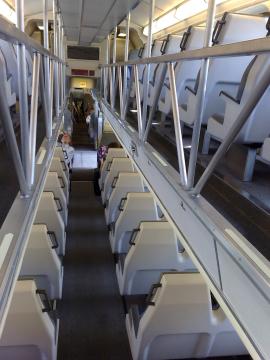
Caltrain passenger coaches are of two types.  “Baby Bullet” trains with newer bi-level Bombardier equipment offer 110-volt AC power outlets with tables for laptops and other electronic devices. 

Older gallery cars also have seating on two levels. Read more about types of trains here. All trains have restrooms, baggage racks, bicycle storage and seating reserved for seniors and people with disabilities. Wheelchair boarding assistance is available at most stops.

Ticket machines are available at all stations. Ticketing is based on the honor “proof of payment” system; if caught on board without a valid ticket during a random inspection, a $271 fine could result in addition to being put off of the train.  

Route Map


another great map can be found here

The right-of-way from San Francisco to San Jose Tamien station is publicly-owned by the Peninsula Corridor Joint Powers Agency. South of San Jose, to Gilroy, Caltrain runs on tracks owned by Union Pacific Railroad, a private company that hauls rail freight.

» Link to official Caltrain website

By the numbers

Route length: 51.4 miles from San Francisco to San Jose and 30 miles from San Jose to Gilroy.
Fastest time between San Jose and San Francisco: 57 minutes.
Daily ridership: ~ 35,000 passengers/day (2006)
Average passenger trip length: 24 miles

34 rail stations in 3 counties: San Francisco, San Mateo, and Santa Clara Counties

96 trains daily on weekday, including 20 Baby Bullet expresses, between San Jose and San Francisco at minimum 30-minute frequency. Trains run approximately hourly on weekends (32 trains on Saturday and 28 trains on Sunday). (FY 2007)

Direct rail connections:  

- SF Muni light rail in San Francisco; indirect connection to BART and Amtrak / Capitol Corridor via bus
- BART heavy rail in Milbrae
- VTA light rail in Mountain View
- ACE commuter rail, Amtrak long distance, Capitol Corridor trains and VTA light rail in San Jose

Governing Body

Peninsula Corridor Joint Powers Board (PCJPB)

Funding


How to support funding for this service

Attend monthly public PCJPB meetings and voice your support and appeal for new funding.
Write or send email to PCJPB members. Contact your local city councilmembers and county supervisors to voice your support for Caltrain electrification and more frequent service.
And of course, ride it whenever you can, and tell your friends about it.

Challenges for this service

The biggest challenge facing Caltrain is its planned electrification.  Electric trains will provide faster starting and stopping, permitting more trains on tighter frequencies.  They will reduce air pollution by eliminating the use of diesel engines.  The plan calls for implementation in 2008 — an ambitious scenario — to 2014.  The standard of 24,000-volt AC overhead power delivery will allow future California high-speed rail to the share Caltrain's right-of-way.  The electrification project also proposes elimination of all grade crossings between San Francisco and San Jose. »More about electrification.

See also Project 2025

History

The railroad we know today as Caltrain has a rich legacy of service, dating back more than 150 years. » Read More About Caltrain's History

Sources:

Caltrain Web site 
Caltrain Strategic Plan: 2004 - 2023
Caltrain Short Range Transit Plan: 2004 - 2013

BayRail Alliance and Caltrain

founding president
Ron Kilcoyne
1982 —  In reaction to Caltrans' neglect and mismanagement of the former Southern Pacific Peninsula Commute Service (the 47-mile, 44-train per weekday service which later became Caltrain), an informal group of advocates begins meeting monthly at the Haven restaurant in downtown SF. Founders include Tony Bruzzone, John Holtzclaw, Doris Kahn, Ron Kilcoyne, Art Lloyd. Peter Straus suggests the name "Peninsula Rail 2000" — because they had a vision for rail that they hoped could be accomplished by the year 2000. Alas, while significant progress has been made on achieving their original vision, it still has not yet come to pass. In 2001, PR2000 became BayRail Alliance.

1983 — PR2000 releases a series of white papers, including "5-Point Program To Develop and Improve Peninsula Rail Service," to extend Caltrain to downtown San Francisco (from Fourth and Townsend to Market or Mission Street), increase its frequency and service hours to approach or match those of BART, operate electric-powered trains (instead of diesel), form a new transit district to operate Caltrain, and use self-service (POP) ticketing. Members hand out newsletters to train riders, make presentations to Peninsula city councils, SamTrans; appear on local radio stations.

1984 — State Senator John Foran, lobbied by PR2000, sponsors Senate Concurrent Resolution 74 (SCR 74). Bill calls for a comprehensive study of rail alternatives for the Peninsula and a local agency to administer and fund train service.

1990 — PR2000 (later known as BayRail Alliance) campaigns with TRAC and PCL to pass Proposition 116, a $1.9 billion bond measure for rail projects, including soon-to-begin Capitol Corridor trains, Caltrain right-of-way purchase. PR2000 wins MTC Award of Merit for its role in the campaign.

1991 — PR2000 (later known as BayRail Alliance) successfully fights California Transportation Commission to release Prop. 116 funds for right-of-way purchase from SP. Purchase later includes Dumbarton line, and trackage rights to Gilroy. CTC releases funds on condition that train service increase to 60 trains per weekday and a stronger local agency is created to run the service.

1992 — PR2000 (later known as BayRail Alliance) successfully lobbies to include Caltrain electrification in Santa Clara County T2010 plan, and in the Measure A half-cent sales tax that is later struck down by the State Supreme Court. Caltrans electrification study confirms key part of 5-Point Plan. Peninsula Corridor Joint Powers Board (JPB) takes over Caltrain from Caltrans. Caltrans electrification study confirms key part of PR2000 5-Point Plan. On two advisory ballot measures, PR2000 helps persuade more San Mateo County voters to support Caltrain than BART. PR2000 heads off proposed SF initiative to prohibit SFO rail shuttle from connecting to Caltrain, an issue which PR2000 ultimately would lose.

September 1992 — PR2000 working with local bicycle advocates succeeds in getting Caltrain to try a pilot Bikes-on-Board program. On November 24, 1995, Caltrain increases the number of bicycles allowed per train to 24 making Caltrain the least-restrictive and most accessible rail system to bicyclists in the country.

1996— PR2000 joins in lawsuit against BART-SFO project now planned to extend to Millbrae, precluding the promised direct connection between Caltrain and SFO AirTrain. Suit ultimately would prove unsuccessful.

2000 — PR2000 successfully lobbies the Santa Clara County board of supervisors to keep a 1996 Measure B promise to voters for more frequent Caltrain service, which results in them putting the squeeze on VTA. VTA provides funding to help boost weekday Caltrain mid-day service from hourly to half-hourly, with matching funds from San Francisco and San Mateo counties.

2001 — BayRail's lobbying efforts help lead to Caltrain agreeing to be the Dumbarton Rail operator. Caltrain agrees on the condition that it would not be required to fund any of the expenses of operating the  Dumbarton service.

September 2003 — After years of delay, Caltrain implements full proof-of-payment fare collection, thereby realizing one of BayRail Alliance's original five goals for Caltrain.