Caltrain DTX

The Caltrain Downtown Extension is part of the San Francisco Transbay Terminal Project.

The plan is to extend Caltrain 1.3 miles through an underground tunnel in San Francisco, to a rebuilt Transbay Terminal near 1st and Mission Streets in the heart of the financial district. The Terminal would connect Caltrain, AC Transit, Golden Gate Transit, and SF Muni, with Caltrain in the basement.
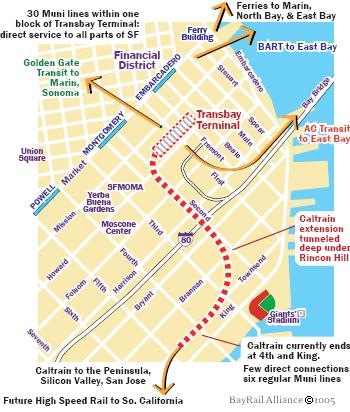
DTX map

While the downtown extension benefits Caltrain and future California high-speed rail, they are not the lead agencies for the project. Responsibility for managing, planning, and building the Caltrain downtown extension belongs to the Transbay Joint Powers Authority.


Getting the downtown extension built was one of our organization's primary goals in the early 1980's. This project has survived near-death on several occasions, pulling through because of the hard work and personal sacrifices of advocates to keep it alive against severe obstacles. We owe a previous and current generation of activists a debt of gratitude for the progress that this project is made. Currently, the environmental documents for the project are complete. The main remaining obstacle is funding.

Please see our Transbay Terminal page for more information.

BayRail Alliance and Caltrain Downtown Extension

1983 — PR2000 releases a series of white papers, including "5-Point Program To Develop and Improve Peninsula Rail Service," to extend Caltrain to downtown San Francisco (from Fourth and Townsend to Market or Mission Street), increase its frequency and service hours to approach or match those of BART, operate electric-powered trains (instead of diesel), form a new transit district to operate Caltrain, and use self-service (POP) ticketing. Members hand out newsletters to train riders, make presentations to Peninsula city councils, SamTrans; appear on local radio stations.

1984 — State Senator John Foran, lobbied by PR2000, sponsors Senate Concurrent Resolution 74 (SCR 74). Bill calls for a comprehensive study of rail alternatives for the Peninsula and a local agency to administer and fund train service.

1985 — Peninsula Rail 2000 (later known as BayRail Alliance), incorporates as a nonprofit. SCR 74 study findings support PR2000 plan for transit-level Caltrain frequency, downtown SF extension to attract more than twice current ridership. PR2000 receives Certificate of Achievement from the Metropolitan Transportation Commission (MTC) for its proposals and efforts to promote them.

1986 — PR2000 fights a proposal to move SF Caltrain terminal further from downtown to make room for Mission Bay development. This threat would persist for several years.

1993 — PR2000 member Michael Kiesling re-invigorates Caltrain SF extension with his affordable proposal to tunnel the line to the Transbay Terminal. The PCJPB purchases the rights to Kiesling's "Emperor Norton" proposal for the nominal sum of $10.

1994-95 — Kiesling’s downtown SF extension alternative nearly eliminated when SF Board of Supervisors approves studies for project. Over a year later, a variant of Kiesling’s plan is found to be the only feasible option. Many Caltrain improvements are put on hold while BART-SFO extension plan moves forward. PR2000 fights proposed JPB ordinance to limit free speech at stations.

1996-98 — San Francisco Mayor Willie Brown opposes the Caltrain downtown extension, and blocks completion of studies needed to build it. This results in reprogramming of funds to “Rapid Rail” plan, emphasizing rehabilitation of rail line before any major upgrades. After SF activists including PR2000 campaign to place a ballot initiative to move the downtown extension project forward, Mayor Willie Brown reverses his position again, to support the downtown extension, shortly before Prop H qualifies for the ballot.

November 2, 1999 — After a campaign by SF-based groups and PR2000, SF voters pass Prop. H with 69% of the vote. It requires city officials to seek funding for, and build, Caltrain downtown extension to a new or rebuilt terminal on the present site of the Transbay Transit Terminal, to protect right-of-way for the extension, and also to "pursue electrification of the Caltrain line from San Francisco to San Jose prior to or concurrent with the extension of Caltrain downtown".

2001 — PR2000 changes its name to BayRail Alliance and launches a campaign for the passage of Assembly Bill 1419, which the state legislature approves by a 1-vote margin, to transfer Transbay Terminal land and development rights from Caltrans to San Francisco Redevelopment Agency to build new terminal and Caltrain extension. The Redevelopment Agency has pledged all of the proceeds (tax increment) from the development to the rebuilding of the Transbay Terminal and Caltrain Downtown extension. This amount is estimated at $1.2B of the $1.8B cost of the project.Governor Davis vetoes the bill, but directs Caltrans to support the land transfer administratively.

April 22, 2004 — BayRail Alliance, working with other groups in San Francisco, overcomes opposition from a greedy developer and some neighborhood interests and convinces the SF Board of Supervisors to approve environmental documents for the Transbay Terminal project, which includes extending Caltrain and future high-speed rail.

June 15, 2004 — In an exhausting hearing that ended past 3 a.m. the next day, BayRail Alliance and other groups succeed in getting the SF Board of Supervisors to unanimously uphold the Transbay EIR against appeals filed by some neighborhood interests and a private developer.

June 7, 2005 — BayRail Alliance, working with TRANSDEF, files a “friend of the court” (amicus) brief along with the Sierra Club, TRAC, San Francisco Tomorrow, and TALC, requesting speedy appeal of a ruling on the Transbay Terminal project’s Environmental Impact Report (EIR). A ruling by a judge in favor of private developer Jack Myers has halted preliminary planning and engineering for the project. The groups ask the appeals court to stay (halt) the judge’s order pending appeal. This succeeds in producing a speedy stay of the order, allowing planning and engineering for the Transbay Project to proceed. Myers later drops the appeal after the City of San Francisco agrees to pay $34 million to acquire his property through eminent domain.

Downtown Extension Milestones

October 1863: Regular service between San Francisco and Mayfield (now California Ave. in Palo Alto) begins. The San Francisco terminal initially is located at 18th and Valencia Streets. The trip takes two hours. At Mayfield, passengers have to board a stagecoach to get to San Jose.

1915:  San Francisco terminal moves to Third and Townsend streets. The station was built to handle crowds for the Panama Pacific International Exposition.

June 23, 1975: Fourth and Townsend terminal opens in San Francisco, replacing the Mission-style station one block east.

1988 — Regional rail agreement settles squabble among transit agencies and officials over which projects to build. Agreement includes Caltrain SF extension opposed by East Bay. San Mateo County voters approve funding to build it and to purchase Peninsula right-of-way. Caltrans initiates study for project. Regional rail agreement settles squabble among transit agencies and officials over which projects to build. Agreement includes Caltrain SF extension opposed by East Bay. San Mateo County voters approve funding to build it and to purchase Peninsula right-of-way. Caltrans initiates study for project.