What is High-Speed Rail?

French TGV and German ICE trains
Source: Flickr
High-Speed Rail (HSR) refers to very fast trains that typically operate at speeds of 125 – 200 mph. Some examples are the TGV in France, ICE in Germany, Shinkansen in Japan, the AVE in Spain, and the KTX in South Korea.
By comparison, Caltrain and BART typically travel at maximum speeds of less than 80 mph, and have average speeds (including station stops) of about 35 mph for local trains. Amtrak’s average speed is about 40 -55 mph with a maximum speed of 79 mph in most areas.
Most U.S. residents have had no experience with high-speed rail because it doesn’t exist yet in the United States in a form comparable to what’s found elsewhere in the world.
Imagine you are traveling from Mountain View to Los Angeles. You take Caltrain from Mountain View to San Jose, then transfer to a high-speed rail train that leaves from San Jose, right on time.
The train that you board looks inviting. It has comfortable seats that are much roomier and have a lot more legroom than on an airplane. It has tray tables that fold down and also a dining area with seats and tables. It has electrical outlets where you may plug in your laptop. You are welcome to get up and walk through the train anytime you need to stretch your legs.
The ride is super smooth – no turbulence – and the air that you’re breathing isn’t stale and dry like on the last airplane flight you took. If you didn’t look out the window to view the landscape speeding by, you wouldn’t believe that you’re traveling at speeds of over 150 mph.
Two and a half hours later, you’re at Union Station in downtown Los Angeles. You wheel your luggage off the train and transfer to one of the local transit lines or a taxi to get to your hotel just a short ride away in downtown.
Your ticket cost less than what it would cost to fly, and you arrive more relaxed than if you’d flown or driven. No fog, wind, or rain delayed your trip. The trains are so punctual, you can almost set your watch by them.
This is the reality in other parts of the world. Japan celebrated 40 years of high-speed rail in 2004. Their first high-speed rail trains are now in museums.
HSR in California

In November 2008, voters in California approved Proposition 1A, a $9.9 billion bond for High Speed Rail. Currently, the California High Speed Rail Authority is preparing environmental documents and conducting engineering studies for HSR between the San Francisco Bay Area, Sacramento, Los Angeles and San Diego. In February 2009, President Obama signed the American Recovery and Reinvestment Act, which provides $8 billion for high speed rail projects nationwide. In January 2010, the Obama administration announced that California will receive $2.34 billion from ARRA.
California High-Speed Rail Authority website
HSR will be built if the state and federal government sustain their commitment to providing money and attracting private investment. BayRail Alliance is participating in the planning process to ensure the project would provide the maximum transportation benefits with the least temporary and permanent impacts to Caltrain riders and the community.
Why HSR?
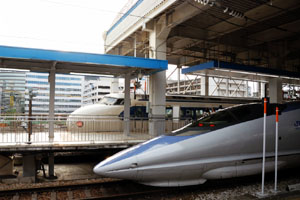
The first generation (1960s) and the current generation of the Japanese Shinkansen trains. Source: Flickr
California’s population will continue to increase in the next forty years. If we build nothing, our whole state will be mired in paralyzing gridlock.
Expanding our highways and airports to provide for an equivalent level of mobility in lieu of HSR, will cost TWICE as much as building HSR. Expanding highways and airports will also destroy important environmentally-sensitive habitat, pollute the air, create more noise and result in our state emitting millions more metric tons of greenhouse gases per year. This is why the Sierra Club has been supportive of the concept of building HSR in California.
Much of the state’s population growth is happening in the Central Valley, and that will be the case whether or not we build HSR to serve those areas. HSR is the best option for improving mobility between the Central Valley and the rest of the state. Specific policies by the HSRA are designed to encourage compact growth patterns in the Central Valley and wherever HSR stations are located.
An estimated 450,000 jobs would be created by its construction, and once the HSR system is built, it would turn a profit and be able to pay for its own operations, as it has in some other parts of the world.
Cost
Originally estimated to be about $40 billion. In 2012, the revised cost estimate for the system from the Bay Area to Los Angeles/Anaheim in Phase 1 (included the blended section) is somewhere between $50 and $60 billion. The initial section in the Central Valley is estimated to cost between $26 to $31 billion.
When?
The High Speed Authority plans to construct the Central Valley segment later in 2013. Diesel trains are expected to run on the newly constructed section as soon as 2016 or 2018. Later phases include electrification, track constructions between the Central Valley and Southern California, Central Valley and the Bay Area, and urban blended sections on the Peninsula and Los Angeles. The phase 1 system is expected to complete in 2028 or 2030. Until the tracks are completed between the Central Valley and the Bay Area, the High Speed Rail business plan calls for a “Northern California Unified Service,” an enhanced conventional rail service via the San Joaquin, Capitol Corridor, and Altamont Corridor to connect with High Speed Rail in Merced.