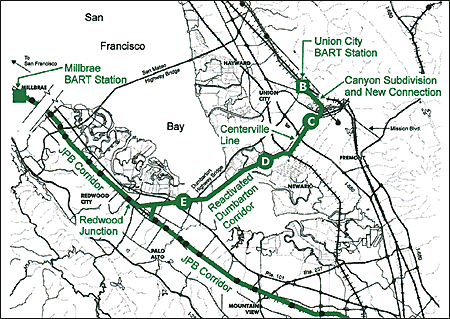
Corridor map
Functioning as a connector to the current Caltrain system, standard rail across a rebuilt Dumbarton Rail Bridge would serve the increasing cross-bay travel market. It will connect riders in Fremont, Newark, Union City, and other east bay cities served by BART, ACE and the Capitol Corridor, to Caltrain on the peninsula.
BayRail Alliance supports the Dumbarton Rail project. It will speed travel from the east bay to the peninsula, and reduce the delays and conflicts that ACE and Amtrak trains currently experience with freight traffic. During rush hour, automobile traffic approaching the parallel Dumbarton automobile bridge is heavily congested, slowing the Dumbarton Express bus and making the bus a less attractive public transit option during peak commute times.
The rail bridge, located just south of where Highway 84 crosses the Bay, was in use until the 1980’s. Riders on Caltrain can see the north and south legs of the wye connecting the Caltrain main line with the Dumbarton line south of the Redwood City Caltrain station. The remains of the Dumbarton rail trestle to the south is also visible to commuters crossing the Dumbarton highway bridge.
Description
The project involves repairing and upgrading damaged rail bridges and tracks spanning the bay between Redwood City and Newark; improving existing tracks and signal controls; constructing three new passenger rail stations in Menlo Park/East Palo Alto, Newark, Union City, and a new layover facility in the East Bay; and upgrading the Fremont Centerville station.
Total corridor length is 20.5 miles, much of which has been in active use for a century. Only a relatively short 5-mile segment has been out of service since the mid-1980s. The Dumbarton rail bridge itself is 310 feet long and the Newark Slough bridge is 188 feet long.
Initial plan for the Dumbarton Corridor adopted by Caltrain in 2000 proposed six round-trips during the weekday commute hours. Morning trains would start from the Union City Intermodal Station, crossing the bay, with three trains heading north on Caltrain to San Francisco and three heading south to San Jose. In the evening, transbay trains would start from San Francisco and San Jose back to Union City.
History
» View historic Dumbarton passenger timetables on Centerville Depot website
The Dumbarton Rail Bridge was built in 1910 by a “paper subsidiary” of Southern Pacific, and was the first bridge to be built across San Francisco Bay.
The line primarily carried freight trains, but from 1912 to at least 1918, it was used to provide a transbay passenger service. Both mixed trains (combined freight-passenger) trains and all- passenger trains traversed the bridge. Parts of the line approaching the bridge are still used today for freight rail.
The rail bridge was no longer used by rail traffic in the mid-1980s. In 1994, San Mateo County acquired the rail bridge and the rail right of way from Southern Pacific for future use.
In 2000, a bill sponsored by State Senators Jackie Speier (D-San Mateo) and Byron Sher (D-Palo Alto), included funding for Dumbarton commuter rail from the ACE route. The bill’s sponsors suggested that these trains could be running as early as 2003. This legislative action led to the establishment of Caltrain’s “Baby Bullet” service in 2004. However, funding for Dumbarton rail was removed from the bill before the bill was approved by the Transportation Committee.
After the Caltrain JPB voted to become the sponsor and operator of the Dumbarton Rail project in 2000, Caltrain and the funding agency San Mateo County Transportation Authority began the process for environmental evaluation. A Policy Advisory Committee was established to include East Bay stakeholders for the project. Dumbarton Rail was included in VTA’s 2000 Measure A sales tax and the 2004 Regional Measure 2 bridge toll increase.
Despite the support for the project from San Mateo County cities, East Bay cities had other priorities. Regional bridge toll funds for the project was diverted to the BART Warm Springs Extension in 2009. In 2013, a few months after a transportation sales tax failed in Alameda County, East Bay cities pull out from the project. The EIR process stopped, and the remaining regional funds were diverted to other transit projects as well as to buy new buses for the Dumbarton Express routes. Dumbarton Rail was not included in the 2016 sales tax that was approved by Alameda County voters. Meanwhile, Caltrain reluctantly supported the funding diversion as it was trying to complete the environmental process and begin electrification of the main line.
However, with increasing traffic in and around the Dumbarton Corridor, communities are taking a second look. Facebook, planning to expand its corporate campus in North Menlo Park, took the initiative to restart the project by contributing $1 million to SamTrans (managing agency for San Mateo County Transportation Authority and Caltrain) in 2015 for a study on all transit options on the Dumbarton Corridor.
Dumbarton Transportation Study, potential public-private partnership
In 2017, the Dumbarton Transportation Study was released and has several recommendations:
Short term (2020): Improve highway bridge approaches and enhance bus service
Medium term (2025-2030): Include HOT lanes on the highway bridge, build busway on the rail right of way for enhanced bus service, rebuild rail bridge and run rail shuttles between Redwood City and Newark.
Long term (2030+): Extend rail service to Union City and interline Dumbarton trains with the Caltrain mainline to SF and SJ.
While the study didn’t initially recommend a bike/ped path on the rail right of way, it was included in the final recommendation due to community pressure. According to the plan, bike/ped path, busway, and rail tracks would co-exist side by side.
To fund these projects, SamTrans is looking for traditional funding sources such as ballot measures, as well as public-private partnership with companies such as Facebook.
FAQ
Green Caltrain updates on Dumbarton Rail
- Rider-friendly service on the Dumbarton Corridor
- Palo Alto joins all-agency BayPass, Caltrain updates single-agency GoPass pricing
- MTC Connected Network Plan identifies transit service gaps on 92 and 84 bridges
- Caltrain board supports engagement with regional governance
- East Palo Alto to consider trip cap, bus lanes, and congestion pricing for Ravenswood Business District Specific Plan